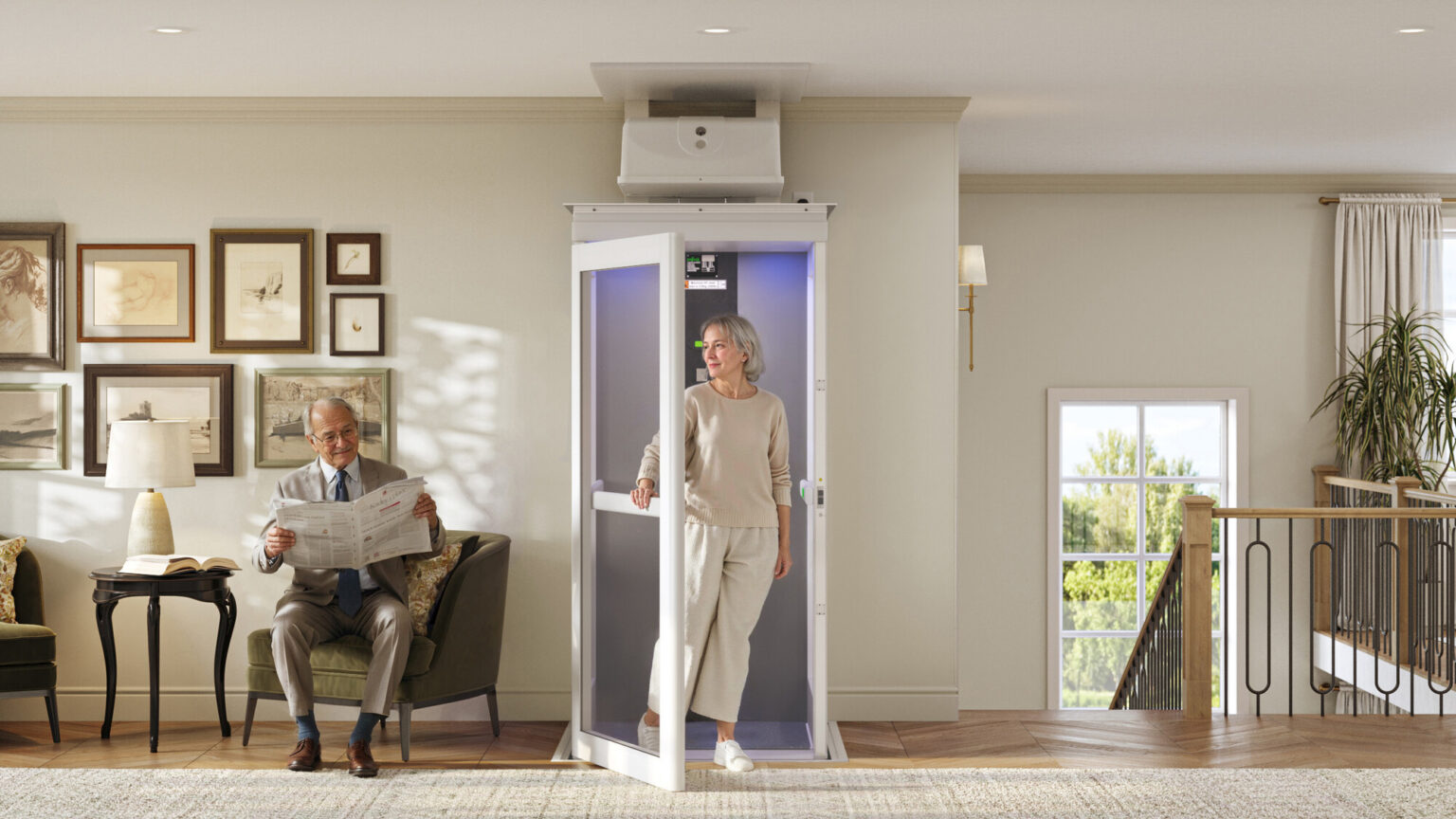
Types of Home Elevators
There are five main categories of residential elevator. Each has strengths, weaknesses, and ideal use cases. The right one for you depends on your home layout, budget, and how you plan to use it.
Hydraulic
Starting around $30,000Hydraulic elevators use a pump that pushes fluid into a piston, lifting the cab smoothly. They are the most common residential elevator style and the technology has been refined for decades.
Typical use case: Two- and three-story homes where a dedicated machine room is available. Excellent for heavier loads and daily use.
Footprint: Roughly 15 to 20 square feet for the cab, plus a small machine room (about 3 by 4 feet) that can be located up to 20 feet away.
Pros
- Smooth, quiet ride
- Handles heavy loads (750–1000 lbs)
- Long proven track record
- Works well in retrofit projects
Cons
- Requires a separate machine room
- Fluid maintenance needed over time
- Slightly slower than some options
Pneumatic (Vacuum)
Starting around $40,000Pneumatic elevators use air pressure to move the cab through a clear cylindrical tube. Turbines above the cab create suction that draws it up, and gravity — regulated by the pressure — brings it down.
Typical use case: Homes where style matters as much as function, and where a compact, freestanding design is preferred. Perfect for retrofits.
Footprint: As little as 30 to 42 inches in diameter. No machine room required. No hoistway or pit required.
Pros
- Minimal construction required
- No machine room or pit
- Striking visual design
- Self-supporting structure
Cons
- Lower weight capacity (typically 450 lbs)
- Noticeable motor noise while moving
- Smaller cab size than traditional elevators
Cable-Driven (Traction)
Starting around $35,000Traction elevators use steel cables and a counterweight system with an electric motor, similar to commercial elevators scaled for residential use. Modern versions use a compact gearless machine mounted at the top of the hoistway.
Typical use case: Multi-story homes where an energy-efficient, quiet ride is a priority, or where a machine room is difficult to locate.
Footprint: Similar to hydraulic (15 to 20 square feet), but the machinery fits above the cab so no separate machine room is required.
Pros
- Energy efficient — uses less power
- Very quiet in operation
- No separate machine room needed
- Long operational lifespan
Cons
- Higher upfront cost in some configurations
- Fewer residential-specific installers
- Requires clearance at top of shaft for machinery
Chain-Driven (MRL)
Starting around $28,000Chain-driven elevators, often called MRL (machine-room-less), use a heavy-duty roller chain instead of steel cables or hydraulic fluid. A motor at the top of the shaft drives the chain, which lifts the cab. They are a newer and increasingly popular option for residential use.
Typical use case: Budget-conscious homeowners who want a compact, reliable system without needing a machine room. Well-suited to new construction or retrofit where space is tight.
Footprint: About 12 to 18 square feet. No separate machine room required. Minimal pit depth.
Pros
- Lower upfront cost
- Compact installation
- No machine room needed
- Fewer moving parts than hydraulic
Cons
- Can be noisier than traction or hydraulic
- Chain requires periodic lubrication
- Shorter history in residential market
Shaftless
Starting around $25,000Shaftless elevators (sometimes called through-floor lifts) travel between two floors through a small opening in the ceiling, without a traditional enclosed shaft. They are the easiest to retrofit into an existing home.
Typical use case: Two-story homes where a traditional elevator would require significant construction. Ideal when a loved one needs quick access to the second floor without a major remodel.
Footprint: As little as 10 square feet. Uses an existing room space — no hoistway or pit. Installation usually completes in just a few days.
Pros
- Lowest cost and simplest install
- Minimal construction disruption
- Works in almost any two-story home
- Fast installation (2–5 days)
Cons
- Only serves two floors
- Smaller cab than full elevators
- Lower weight capacity (typically 500 lbs)
- More visible than traditional installations
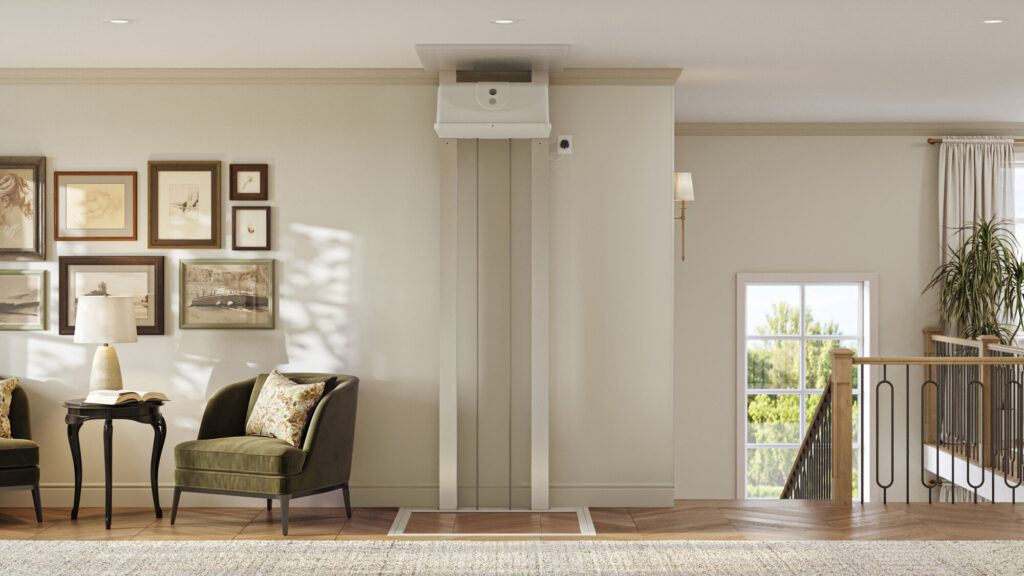
Key Things to Consider Before Buying
Before talking to any company, spend an afternoon thinking through these eight considerations. The clearer you are on what you need, the better conversations you will have.
Home structure and available space
Not every home is a simple fit. A stacked closet, an unused corner, or the space next to a stairway often becomes the elevator location. Consider whether you are open to minor remodeling, or whether you need an option that works without touching the existing structure.
Number of floors
Most residential elevators serve two or three floors. If you have a four-story home or a home with split levels, your options narrow — and the price increases. Know how many stops you need before you start shopping.
Weight capacity needs
Think beyond the present. Common reasons to size up: a wheelchair or walker, a spouse who may need to ride along, large grocery loads, or future-proofing for mobility needs. Standard capacities range from 450 to 1000 pounds.
Aesthetics and cab finish options
Your elevator will be a visible part of your home for 20+ years. Look at cab finishes (wood, laminate, glass, metal), lighting, flooring, and gate or door styles. Many manufacturers offer custom finishes that blend with your interior.
Safety features to look for
At minimum, insist on battery backup, an emergency brake, door interlocks (cab cannot move unless doors are closed), an emergency stop button, and a phone or two-way communication system. We cover safety in depth below.
Noise level
Every elevator makes some noise. Hydraulic and traction are typically the quietest; pneumatic is the loudest due to the vacuum motor. If your elevator is near a bedroom or home office, ask for decibel ratings and, if possible, hear a unit in person before buying.
Maintenance requirements
All home elevators need periodic service — typically once or twice a year. Maintenance includes lubrication, cable or chain inspection, fluid checks, and safety system tests. Budget roughly $200 to $500 per service visit.
Warranty terms
Warranties on residential elevators vary widely. A strong warranty covers parts for at least 2 years and major components (motor, controller) for 5 or more. Ask what is NOT covered, and get the terms in writing before signing.
Home Elevator Safety
Home elevators are remarkably safe when installed and maintained properly. That said, safety is not automatic — it is the result of good design, proper installation, and regular service. Here is what matters most.
Required safety features
Any modern residential elevator should include the following as standard. If a company sells you one that is missing any of these, walk away.
- Battery backup — lowers the cab to the nearest floor and opens the doors during a power outage
- Emergency brake — automatically engages if the cab moves faster than a preset limit
- Door interlocks — prevent the cab from moving unless all doors and gates are fully closed and latched
- Emergency stop button — allows the rider to halt the cab immediately from inside
- Two-way phone or emergency communication — required by code in many jurisdictions
- Cab lighting with emergency backup — interior remains lit during outages
- Slack-cable safety (on traction and chain systems) — stops the cab if a cable or chain goes slack
- Overload sensor — prevents operation if the cab is loaded beyond its rated capacity
Industry standards
The primary safety standard for residential elevators in North America is ASME A17.1 / CSA B44 — Safety Code for Elevators and Escalators. Section 5.3 of this code specifically covers private residence elevators. Any reputable elevator installed in your home should meet or exceed these standards. Ask to see documentation that confirms compliance.
In addition, most elevators should meet local building codes, which often reference ASME A17.1. Your installer should handle the permitting process and inspection, and should provide you with copies of the permit, inspection records, and any certification documents.
What to ask an installer about safety
- Which ASME A17.1 edition does this elevator comply with?
- Can you show me the certification documents?
- Who performs the final inspection, and will you provide a copy of the inspection report?
- What safety features are standard on this model, and which are optional add-ons?
- How often does it need service, and what exactly is covered in a service visit?
Battery backup and power outages
A sudden power outage is one of the most common concerns for home elevator owners. The good news: every modern residential elevator should include an automatic battery backup system. When the power cuts out, the elevator will automatically lower the cab to the nearest floor and open the doors. If someone is riding when power is lost, they will be delivered safely to a floor — not trapped between levels.
Battery backup systems typically need replacement every 5 to 7 years. A good installer will include battery health checks in every service visit.
Maintenance frequency
Residential elevators should be serviced at least once a year. Homes with heavy daily use, or homes where the elevator is critical to a person’s mobility, should schedule service twice a year. A standard service visit includes inspection of cables or chains, lubrication of moving parts, fluid checks (for hydraulic units), battery testing, safety device testing, and a full operational check.
Will a Home Elevator Work in My Home?
This is the most common question we hear — and the answer is usually yes. Most homes can accommodate some type of residential elevator. The question is which type, and what will the installation process look like?
Space requirements
A full-sized residential elevator typically needs a footprint of 15 to 20 square feet — roughly the size of a standard closet. Compact options like shaftless lifts and pneumatic elevators need even less, as little as 10 square feet. The key is finding a stacked vertical path through the home — often a closet aligned on both floors, an unused corner, or the space adjacent to a stairway.
Shaft vs. shaftless options
A shaft (or hoistway) is the enclosed vertical passage the elevator travels through. Traditional elevators require one. Shafts are typically built from framed walls and can be integrated into a remodel, new construction, or retrofitted into an existing stacked closet space.
Shaftless options skip the enclosed shaft entirely. They use a small opening in the ceiling and a self-supporting frame. These are ideal for homes where adding a shaft would require major structural work.
Is new construction required?
No — the majority of home elevator installations are retrofits into existing homes. Most reputable installers will visit your home, assess the space, and propose a location that minimizes disruption. Typical retrofits involve framing a new shaft in an existing closet stack, modifying floor openings, and installing the elevator and its doors. Work usually takes 2 to 6 weeks from start to finish, though much of that is waiting for inspections.
Retrofit considerations
Retrofits usually require opening up floors, modifying framing, and adding electrical service. Expect some drywall and finish work after installation. If you have a basement or crawlspace, a small pit (about 12 inches deep) may need to be dug beneath the elevator. Homes on slabs may require a different type of elevator that does not need a pit.
Rough rule of thumb on home candidates
Strong candidates: two- or three-story homes with at least one stacked closet or corner, homes with attached garages that can support a shaft, and homes with room for a compact freestanding unit. Harder cases: homes with highly unusual framing, homes with no vertical alignment between floors, and single-story homes that simply do not need a full elevator (a stair lift may serve better).
How Long Home Elevators Last
A well-built residential elevator is a long-term investment. With proper service, it should outlast most other major home systems.
Typical lifespan
The typical residential elevator lasts 20 to 30 years with regular maintenance. Some hydraulic units installed in the 1980s and 1990s are still in daily operation today. Traction and chain-driven systems, being newer to the residential market, are expected to last at least as long based on commercial equivalents.
Key components wear at different rates: batteries (5–7 years), hydraulic fluid (every 5–10 years), cables (10–15 years before potential replacement), and electronic controllers (15–20 years). The cab itself — frame, finishes, doors — often lasts the full lifespan of the elevator.
Service intervals
Schedule professional service at least once a year. Heavy-use homes should consider twice-yearly service. A typical visit takes 1 to 2 hours and covers inspection, lubrication, safety testing, and any minor adjustments. Cost is usually $200 to $500 per visit.
How to tell when yours needs attention
Watch for these signs between service visits:
- Unusual noises — grinding, clicking, or squealing
- Jerky or uneven motion during rides
- Slower-than-normal travel speed
- Doors that hesitate to open or close
- Warning lights or error codes on the controller
- Cab that does not level properly with the floor
Any of these is worth a service call. Small issues addressed early prevent larger, more expensive problems down the road.
10 Questions to Ask a Home Elevator Company
Before you sign anything, ask these ten questions. Any honest company will answer them directly. Vague answers, pressure to move quickly, or evasion on any of these is a warning sign.
-
What type of elevator are you recommending for my home, and why?
A good answer describes your specific home, explains the trade-offs, and offers more than one option where appropriate. A bad answer is a generic pitch for a single product.
-
Can you provide a written, itemized proposal?
Equipment, labor, permits, electrical work, finishes, and any construction costs should all be broken out. If a company only gives you a single “installed price” and refuses to itemize, that is a problem.
-
What is your installation timeline, and what does the process look like?
Expect a clear week-by-week plan: permitting, site prep, framing, elevator installation, inspection, and finish work. Vague timelines suggest the company does not plan carefully.
-
Which ASME A17.1 edition does the elevator comply with?
Every reputable company will know this off the top of their head. It should match the edition required by your local jurisdiction.
-
What safety features are standard, and which are optional?
Battery backup, door interlocks, emergency brake, emergency communication, and emergency lighting should all be standard. If any of these are “upgrades,” question why.
-
What is the warranty, and what exactly does it cover?
Ask for the warranty in writing. Pay attention to what is NOT covered — cosmetic damage, misuse, and wear items are common exclusions.
-
Who will perform ongoing service, and what does a service visit include?
Ideally, the installer also services what they install. Confirm response times for service calls and whether emergency service is available.
-
Can you provide references from past residential installations?
Two or three recent customers should be willing to talk to you. This is one of the best ways to verify the company delivers what it promises.
-
What happens if the project takes longer than planned or costs more than quoted?
Good contracts have clear terms for delays and cost overruns — who pays, and what options you have. Get this spelled out in writing, not verbally.
-
Are you licensed, insured, and bonded for residential elevator installation?
Ask for copies of the license and insurance certificates. A reputable company will provide these without hesitation.

What to Watch Out For
We’d rather you spot these red flags and walk away than find out after installation. Here are the warning signs of a company you should not hire.
Vague pricing or refusal to itemize
A reputable company will break down costs for equipment, installation, permits, electrical work, and finishes. “Call us and we’ll work something out” is not a proposal — it is a negotiation trap.
Refusal to provide a written proposal
Every detail — equipment model, specifications, timeline, payment schedule, warranty terms — should be written down and signed before work begins. Verbal agreements protect no one.
Aggressive sales tactics or “limited-time” pressure
Home elevators are not impulse purchases. Any company pushing you to “sign today for 20% off” is relying on pressure rather than the quality of their work. Walk away.
Extremely short or vague warranties
A 90-day warranty on a $40,000 piece of equipment is a red flag. Industry-standard warranties cover parts for at least two years and major components for five or more. If the warranty is shorter or the company cannot explain exactly what is covered, that is a problem.
No license or refusal to prove licensing
Residential elevator installation requires licensed contractors in almost every jurisdiction. Ask for the license number and verify it with your state’s contractor board before signing.
Large upfront deposits (more than 25%)
A reasonable deposit is 10–25% to cover equipment ordering. A company asking for 50% or more up front is either undercapitalized or planning to use your money for another project.
Cannot or will not provide references
Every established company has satisfied customers. If the company you are considering cannot produce two or three local references, they either lack a track record or have reasons for not wanting you to talk to past customers.
No permitting process mentioned
Residential elevators require permits in almost every jurisdiction. A company that says “we don’t bother with permits” is planning unpermitted work — which can invalidate insurance, affect your home’s resale value, and leave you liable for violations.
You’ve Done the Homework. Now What?
If you’ve read this far, you know more about home elevators than most buyers do on purchase day. The next step is a conversation. We’re happy to answer specific questions about your home, your situation, and your options — with no obligation.